


Infrared-Thermometers

Get inspired with expondo blog








Infrared thermometers for fast, non-contact temperature checks
Infrared thermometers are the go-to choice when you need a quick reading without touching the surface. By sensing infrared energy and converting it into a temperature value, they let you work safely around hot parts, moving components, live electrical systems or hard-to-reach areas. Whether you are verifying process temperatures, checking equipment condition, or carrying out routine inspections, these instruments help you make confident decisions in seconds.
Because there is no contact, you can measure from a comfortable distance and avoid contaminating sensitive surfaces. That makes infrared thermometers particularly useful for busy workshops, maintenance teams, facilities management and quality control environments where speed, hygiene and repeatability matter. Many models are designed for everyday handling, with a comfortable grip, clear screens and straightforward controls—ideal when you are taking frequent readings throughout a shift.
Infrared thermometers also support consistent routines: point, scan, confirm, and move on. Features such as backlit displays, fast response times and data-hold functions help you capture readings even in low light or awkward positions. If you are building a wider toolbox of instruments, you can also explore our broader measurement range to cover additional checks across your site.
Choosing the right infrared thermometers: key features and popular types
Different tasks call for different infrared thermometers, so it is worth matching the instrument to your surfaces, distances and temperature ranges. A practical starting point is the distance-to-spot ratio, which indicates how large an area is averaged at a given distance. For precise work on small targets—such as bearings, terminals or narrow pipework—select a model that can read a smaller spot from further away. For broader surfaces and general inspections, a standard ratio is often ideal and keeps operation simple.
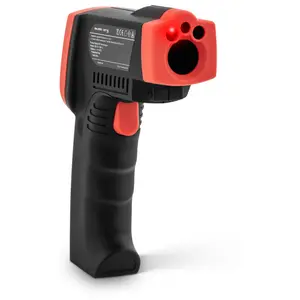
Handheld “pistol-grip” infrared thermometers are a versatile everyday option. They are quick to aim, comfortable for repeated use and well suited to routine checks on motors, pumps, vents, radiators and production lines. Many are equipped with a laser pointer to help you target the measurement area and reduce guesswork when you are moving between multiple checkpoints.
For demanding industrial settings, high-temperature infrared thermometers extend the measurable range for hot machinery, furnaces, moulds, and heated process components. These models are designed to keep readings stable at elevated temperatures and are a strong fit when overheating detection and process verification are critical. If you frequently work around reflective metals, painted parts or varied surface finishes, consider infrared thermometers with adjustable emissivity. By tuning emissivity, you can improve accuracy across different materials and get more dependable results when conditions change.
Some users prefer enhanced aiming support, such as dual-laser guidance or tighter optical focus, especially when checking small components at a distance. Practical details—like a robust housing, protective carry case, and an intuitive interface—also make a big difference on site. If your workflow requires keeping records over time rather than single spot checks, infrared thermometers can be complemented with temperature data loggers to capture trends, document compliance, or support maintenance reporting.
Infrared thermometers for maintenance, HVAC and environmental monitoring technology
Infrared thermometers shine in preventive maintenance, where early detection saves time and reduces downtime. A quick scan can reveal hotspots on bearings, belts, electrical connections and motor casings before problems escalate. In facilities and HVAC work, they help confirm supply and return temperatures, identify heat loss, check radiators and pipework, and support efficient troubleshooting—without dismantling panels or interrupting operation.
They are also helpful for general site checks where temperature is a key indicator of performance. Use them to verify surface temperatures on storage areas, delivery bays, equipment housings or workpieces during production. Because readings are instant, you can compare multiple points quickly and spot unusual patterns. For best results, keep in mind that infrared thermometers measure surface temperature, not internal temperature, and that shiny or highly reflective surfaces can influence readings. Choosing a model with adjustable emissivity and taking readings from consistent angles can greatly improve repeatability.
If you are developing more structured inspection routines, infrared thermometers integrate neatly into broader monitoring practices. They can serve as your rapid screening tool, flagging areas that deserve closer investigation or longer-term tracking. When paired with a considered plan for logging and analysis, they support smarter decisions about servicing, energy use and process stability, and can sit alongside other environmental monitoring technology for a more complete picture of site conditions.
From quick spot checks to regular inspection rounds, infrared thermometers offer a compelling blend of speed, safety and practicality. With options ranging from straightforward handheld models to advanced units with better optics and emissivity control, you can choose a tool that fits your environment and helps you work with confidence every day.