


Laboratory Water Baths
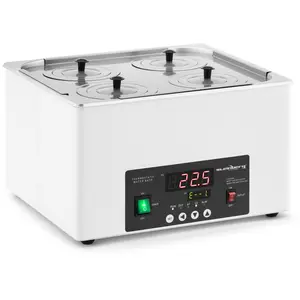

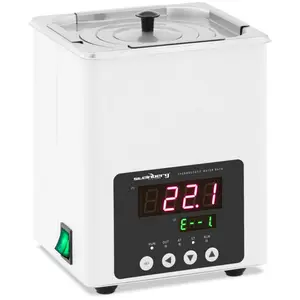
Thermostatic water bath - digital - 14,6 l - 5 - 100 °C - 325 x 300 x 150 mm
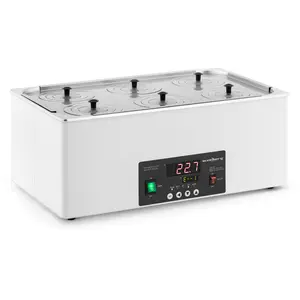
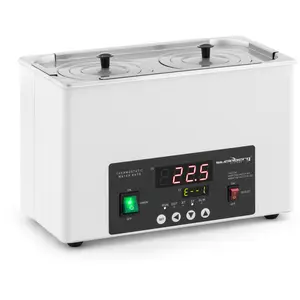
Thermostatic water bath - digital - 22.5 l - 5 - 100 °C - 500 x 300 x 150 mm
- First
- 1
- Last
Get inspired with expondo blog




Laboratory water baths for dependable, even heating
Laboratory water baths are a staple for any workspace that needs gentle, uniform temperature control without the risks of direct heat. Whether you are warming reagents, thawing samples, running enzyme reactions, conditioning media, or maintaining a stable set point for quality checks, a well-built water bath provides consistent performance you can trust day after day. By transferring heat through water rather than hot plates or open flames, these units help protect sensitive materials from hotspots and temperature spikes, making them a natural choice for repeatable methods and reliable results.
Within this category you will find practical solutions designed for routine laboratory workflows, including the classic laboratory water bath for general warming tasks and the popular thermostatic water bath for applications where exact set temperatures matter. Temperature stability is central to good laboratory practice, so these water baths are built to maintain controlled conditions across the tank, helping you achieve reproducibility across batches, operators, and shifts. Clear controls and readable displays support confident set-up, while robust housings and easy-clean surfaces help keep the work area hygienic and efficient.
Because many protocols rely on holding a temperature for extended periods, a good water bath is not only about heating up quickly but also about staying steady over time. That steadiness can make a meaningful difference in routine assays and sample preparation, especially when timing and temperature need to align precisely. Paired with careful measurement tools such as precision scales, laboratory water baths support controlled, methodical workflows where repeatability is the priority.
Thermostatic laboratory water baths and stirred options for consistent results
If your work depends on tight temperature control, a thermostatic water bath is a strong, versatile choice. Thermostatic regulation helps maintain a constant set point, reducing drift and supporting long holds at stable temperatures. This is particularly valuable for temperature-sensitive reactions, pre-heating steps, viscosity conditioning, or any process where “close enough” is not good enough. With straightforward controls and stable heating performance, these models are well suited to everyday lab routines as well as more demanding procedures that require reliable, documented conditions.
For tasks where uniformity across the bath is critical, or when you are working with viscous liquids that benefit from mixing, a water bath with magnetic stirrer adds an extra layer of control. Gentle circulation can help reduce temperature gradients, promoting a consistent environment around tubes, bottles, and vessels throughout the tank. This can be especially helpful when you need an even thermal profile for multiple samples at once, or when you are aiming to standardise results across different positions in the bath.
Practical design details matter in daily use. A spacious tank supports multiple vessels, while smooth interior surfaces make cleaning quicker and help prevent residue build-up. Stable lids can reduce evaporation and improve temperature stability, supporting longer protocols with less topping up. Controls designed for quick adjustments help you respond promptly to method changes, and clear labelling keeps operation intuitive for shared environments where several team members use the same equipment.
Choosing laboratory water baths for your workflow, capacity, and temperature range
Selecting the right laboratory water bath comes down to matching the unit to your routine: what temperatures you need, how much capacity you require, and how many samples you handle at once. If your primary need is simple warming or thawing, a standard laboratory water bath can be an efficient, straightforward solution. If you regularly run protocols that depend on holding a specific temperature for long periods, a thermostatic water bath provides added confidence with stable regulation. Where mixing and homogeneity are important, the water bath with magnetic stirrer helps improve consistency across the tank and can support more demanding preparation steps.
Think about vessel types and day-to-day handling, too. Some labs routinely use tubes and racks, while others need space for larger bottles or flasks. Choosing a suitable tank size helps keep your workflow organised, reduces crowding, and supports better heat transfer around each item. It can also help you plan how you will position samples for efficient retrieval and minimal disruption when you need to add or remove items during a run.
Laboratory water baths often sit at the centre of a broader temperature-control set-up. For example, chilling and controlled storage can be supported by laboratory coolers, while stable warm environments for growth, cultivation, or long-duration conditioning are typically handled by laboratory incubators. In this context, water baths play a key supporting role: they offer rapid, uniform heating and stable holding conditions that complement cooling and incubation equipment, helping you build a dependable end-to-end process from preparation to storage.
Finally, consider ease of maintenance and long-term practicality. Equipment that is easy to drain, wipe down, and keep free from contamination will save time and help protect your results. A well-chosen water bath supports smooth routines, reduces rework, and makes it easier to keep procedures consistent across your team. Whether you need a reliable general-purpose laboratory water bath, a controlled thermostatic water bath, or a stirred model for enhanced uniformity, this category is designed to help you maintain the temperatures your work depends on.