


Blast Chillers

Get inspired with expondo blog



Blast chillers for fast, controlled food cooling
A blast chiller gives professional kitchens a fast and controlled way to reduce the temperature of freshly cooked food before storage, further preparation or service. Unlike an ordinary refrigerator, which is primarily designed to keep already chilled food cold, blast chillers use powerful circulated cold air to remove heat rapidly from the product.
That makes a commercial blast chiller particularly useful in restaurants, hotels, bakeries, cafés, canteens and catering businesses that cook in batches or prepare menu components in advance. Faster cooling helps shorten the period in which warm food is exposed to temperatures favourable to bacterial growth, while also helping preserve texture, appearance and moisture.
The Food Standards Agency recommends cooling cooked food as quickly as possible before refrigerated storage and specifically identifies blast chilling as a suitable method for businesses handling larger quantities. For a professional kitchen, a blast chiller therefore supports not only efficient production but also a more controlled food-safety routine.
At Expondo, the Royal Catering range covers everything from a small blast chiller for compact kitchens to a 276 L model capable of handling substantial commercial batches. Each model can both rapidly chill and freeze food, allowing you to choose capacity according to your production volume rather than buying separate appliances for each process.
Which blast chiller is right for your kitchen?
Capacity should be one of the first things you compare. The useful figure is not simply the internal volume: consider how many kilograms of food the appliance can process in a cycle, which trays it accepts and how many batches you expect to run each day.
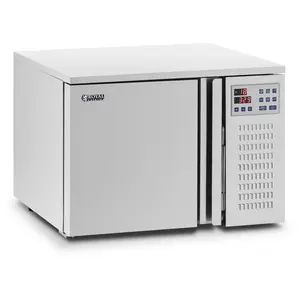
- 29.5 L blast chiller: the most compact model in Expondo’s current range measures 62.8 × 61.5 × 47.7 cm. It accommodates three GN 1/2 containers, or a combination of two GN 2/3 containers and one GN 1/2. Its specified blast-cooling performance is 7 kg from +90°C to +3°C in 86 minutes, with blast freezing of 4 kg to -18°C in 209 minutes. It is a practical option where space and batch size are limited.
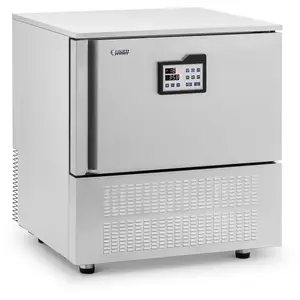
- 96 L blast chiller: suited to growing restaurant, bakery and catering operations, this model accommodates five GN 1/1 containers or five 600 × 400 mm baking trays. It can chill 14 kg from +90°C to +3°C in 90 minutes and freeze 12 kg to -18°C in 238 minutes.
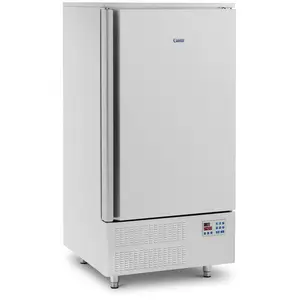
- 276 L commercial blast chiller: designed for considerably higher output, this model holds ten GN 1/1 containers or ten 600 × 400 mm baking trays. Its stated capacity reaches 40 kg of blast chilling in 90 minutes and 35 kg of blast freezing in 230 minutes, making it particularly useful for high-volume batch production.
Rather than choosing the biggest machine available, match the capacity to the amount of hot food normally produced at one time. An oversized unit may take up valuable kitchen space, while an undersized blast chiller can create a bottleneck if staff must wait for several consecutive cycles.
Small blast chiller or larger commercial blast chiller?
A small blast chiller can be the better choice for cafés, smaller restaurants, patisseries and kitchens with restricted floor space. If you are searching for a countertop blast chiller, Expondo’s 29.5 L model is the most compact option in the range; always check the dimensions, available supporting surface, ventilation clearances and installation requirements before deciding where to position it.
Medium-volume businesses may benefit more from the 96 L model. Its five GN 1/1 or bakery-tray positions provide substantially more batch capacity while keeping the overall dimensions manageable for a professional kitchen.
For hotels, production kitchens, larger restaurants and busy catering operations, the 276 L model reduces the need to divide production into multiple small cycles. If you are comparing equipment marketed as an industrial blast chiller, look beyond the terminology and compare actual kilograms per cycle, tray compatibility and physical dimensions. Those figures give a much clearer indication of whether the appliance can keep pace with your kitchen.
Blast chiller fridge vs standard commercial refrigeration
Customers searching for a blast chiller fridge are often deciding whether rapid cooling can be handled by an ordinary commercial refrigerator. The two appliances perform different jobs.
A standard fridge is built principally to maintain food at a low temperature. Loading it with large quantities of freshly cooked, hot food can increase the temperature inside the cabinet and place additional strain on the refrigeration system. A blast chiller is designed specifically to pull heat out of hot food quickly before that food moves into normal chilled storage.
For this reason, blast chilling and conventional commercial refrigeration work best as complementary parts of the same cold chain. Use the blast chiller for rapid temperature reduction, then transfer appropriately cooled and labelled food to suitable refrigeration for storage.
The same principle applies when freezing. A blast chiller freezer or combination blast chiller and freezer is designed to take food down to freezing temperatures more rapidly than standard storage equipment. The Royal Catering models available here offer both chilling and freezing functions, so the same unit can support different production requirements.
What can you use a blast chiller for?
Blast chillers are particularly valuable for foods prepared in batches. Soups, sauces, stocks, cooked meats, fish, vegetables, pasta dishes and prepared meals can be cooled efficiently before refrigerated storage. This can make production easier to organise around quieter periods rather than forcing every preparation task into the hours immediately before service.
Bakeries and patisseries can also benefit. The 96 L and 276 L Royal Catering models accept 600 × 400 mm baking trays as an alternative to GN 1/1 containers, making them relevant to businesses preparing pastries, desserts and other bakery products.
Rapid cooling can also help with presentation and consistency. Delicate prepared foods may retain their structure better when heat is removed efficiently, while chilled desserts become easier to portion and finish once they have reached the required temperature.
For outside caterers, hotels and event kitchens, a blast chiller can support advance preparation of larger quantities, helping to separate production from final service. In busy operations, that can improve workflow, make batch sizes more predictable and reduce pressure during peak periods.
Features to consider when buying a commercial blast chiller
Start with chilling capacity rather than internal litres alone. A 96 L cabinet that cannot process your normal batch in one cycle may be less useful than its volume suggests. Compare the kilograms that can be reduced to the specified target temperature within each cycle.
Tray compatibility is equally important. Kitchens already working with Gastronorm containers can minimise unnecessary food transfers by selecting a blast chiller that accepts the same format. Bakeries should pay particular attention to 600 × 400 mm tray compatibility.
The Royal Catering models use stainless steel construction, a practical choice for intensive catering environments because the smooth, durable surfaces are straightforward to clean. Digital LED or LCD controls provide clear access to operating settings, while the different capacities allow buyers to select a machine around actual production volume.
Footprint also matters. Measure not only the final installation position but the route into the kitchen, doorways and the working clearance around the unit. A powerful commercial blast chiller is only useful if it integrates comfortably into the production line.
Finally, remember that rapid chilling equipment should form part of a planned workflow. Avoid overloading trays or restricting airflow around food, and follow the operating instructions for the individual appliance. Correct loading helps cold air circulate efficiently and contributes to repeatable results.
From blast chilling to an efficient kitchen workflow
The best position for a blast chiller is usually close enough to the cooking and preparation area to minimise unnecessary handling, while still leaving adequate ventilation around the appliance. Once food is chilled, it should move logically towards storage, portioning or packaging.
Organised kitchen cabinets can help keep GN containers, utensils an d packaging close to the preparation area, reducing movement through a busy kitchen. Building a clear sequence from cooking to chilling and onward storage makes it easier for staff to follow consistent procedures.
This workflow is useful beyond large restaurants. Cafés, bakeries and hotel breakfast operations can combine efficient food preparation with service equipment such as professional coffee makers, creating a workspace in which preparation, cold storage and customer service each have a clearly defined place.
Choose a blast chiller from Expondo!
Expondo’s range provides a straightforward capacity progression instead of forcing buyers to compare dozens of unrelated machines. The compact 29.5 L appliance addresses smaller batches and limited spaces, the 96 L model brings five-tray GN 1/1 and bakery compatibility, and the 276 L unit provides ten-tray capacity for significantly larger production volumes.
All three Royal Catering blast chillers combine rapid chilling and freezing in one appliance and use easy-clean stainless steel construction. Clear technical data makes it possible to compare physical dimensions, container compatibility and processing capacity before ordering, while product pages also provide manuals and supporting technical information.
Whether you need a small blast chiller for a compact preparation area, a versatile five-tray machine or a high-capacity commercial blast chiller, choosing the right size can make batch production faster and more predictable. Compare the amount of food you need to process, your available space and the tray formats already used in your kitchen, then select the blast chiller that fits naturally into your daily workflow.