


Planer Machines

Get inspired with expondo blog


Planer machines for clean, consistent timber preparation
Planer machines are the workshop essential for turning rough-sawn boards into accurately sized, smooth timber that is ready for joinery, furniture making, fitting out and general building work. Whether you are squaring stock for frames, reducing boards to a uniform thickness, or refreshing reclaimed wood, a reliable planer helps you achieve repeatable results with less effort and less waste.
Within this category you will find planer solutions designed to suit different working styles, from compact benchtop thickness planers for smaller workshops through to robust machines built for regular production tasks. The aim is always the same: stable feeding, an even cut, and a finish that looks professional straight off the cutterhead. For anyone who values accuracy and time-saving workflow, planer machines quickly become a cornerstone of day-to-day timber preparation.
Many users pair planing with other finishing and site-prep steps, so it is helpful to think of planers as part of a wider, tidy process. After planing, surface refinement is often completed with electric sanders, while outdoor projects may call for ground clearance equipment such as stump grinders. If you are building a coordinated workshop setup, our broader range of power tools can help you keep every stage of the job efficient and consistent.
Choosing planer machines: thickness planers, jointer planers and handheld planers
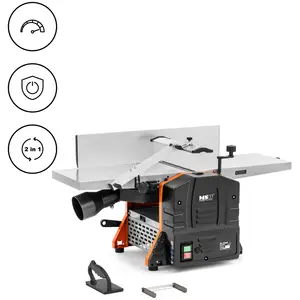
The right type of planer depends on how your timber arrives and what accuracy you need. A thickness planer is ideal when you want boards to emerge at a consistent final thickness. It uses a powered feed to draw material through at a set height, producing uniform results across multiple pieces. This makes it a practical choice for batch work, cabinetry components and any job where matching thickness matters for fit and appearance.
If your boards are not flat or have a twisted face, a jointer planer (also known as a surface planer) is designed to flatten one face and true an edge before thicknessing. This sequence helps you create a straight reference surface, which is essential for tight joinery and stable assemblies. Many workshops value this approach because it improves accuracy from the start, reducing the need for repeated adjustments later in the build.
For mobile work or on-site fitting, a handheld planer offers flexibility. It is particularly useful for easing doors, trimming edges, refining scribing lines, and correcting small high spots where bringing material to a stationary machine is impractical. Handheld planers are also a good companion tool for quick corrections during installation, helping you keep projects moving without compromising on finish.
To choose confidently, consider your typical board widths, the maximum thickness capacity you require, and how frequently you will be planing hardwoods versus softwoods. If you regularly handle wider stock, a machine with a generous planing width reduces the need for multiple passes and helps preserve a consistent surface. For repeated tasks, features like stable infeed and outfeed support, clear controls and dependable depth adjustment can make a noticeable difference to both accuracy and operator comfort.
Planer machines that support productivity, safety and a great finish
A good planer machine should feel predictable: the timber feeds smoothly, the depth setting stays where you put it, and the cut looks even from end to end. Look for a solid build with rigid tables and dependable alignment, as stability is the foundation of consistent results. A clear, easy-to-read depth scale helps you make controlled adjustments, while a sensible range of cutting depths allows you to remove material efficiently without overloading the machine.
Finish quality is influenced by cutter condition, feed consistency and sensible pass depth. Sharp blades reduce tear-out and leave a cleaner surface, particularly on figured grain. If you are aiming for the best results on visible faces, taking lighter finishing passes can improve the surface and reduce the time required for any final refinement. Consistent feeding also helps prevent snipe at the start or end of a board, and well-supported infeed/outfeed work improves results on longer stock.
Dust management is another important part of professional planing. Planing produces a high volume of shavings very quickly, so a machine designed with practical extraction options helps keep the work area cleaner and visibility better. Good chip control also supports the cut by reducing the chance of waste building up around the cutter area, which can affect feeding and surface quality.
Safety and usability matter just as much as output. A well-designed planer machine encourages correct working practices with straightforward controls and stable handling. Choosing a model that suits your space and workflow can reduce awkward lifting and repositioning, especially when you are preparing multiple boards in one session. With the right planer machine in place, you can approach each project with confidence, knowing your timber will be accurately prepared, beautifully finished and ready for the next stage of your build.