


Drills

Get inspired with expondo blog



Drills for accurate core drill work and professional openings
When your job calls for neat, repeatable cut-outs rather than rough holes, a dedicated core drill is the tool that keeps every stage controlled. Designed for demanding site and workshop use, these drills provide the stability and torque needed to bore clean apertures for pipe runs, cable routes, ventilation ducts, anchoring points, and service penetrations. The focus is on accuracy, reduced breakout, and dependable performance where surface finish and positioning matter.
A core drill is ideal when you need to remove a precise cylinder of material instead of pulverising the surrounding area. Used with suitable core bits, it helps you create smooth-edged openings in masonry and other tough substrates, supporting tidy installations and easier follow-on work. Whether you’re planning a single pass-through for plumbing or repeating the same diameter across multiple locations, core drilling keeps the result consistent and professional.
Because drilling tasks often vary widely across projects, it can be helpful to view your wider tool options alongside specialist models; you can explore our drills and screwdrivers range to match the right machine to the right application without compromising on handling or power.
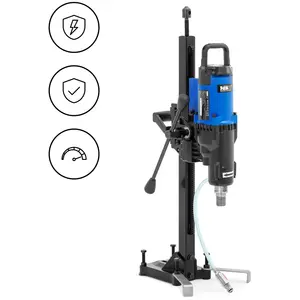
Core drill with stand solutions for clean, repeatable alignment
For jobs where precision is non-negotiable, a core drill with stand turns careful measuring into confident execution. The stand guides the drill through a stable, vertical travel, helping you maintain the correct angle and reducing the risk of wandering at the start of the cut. This is especially valuable for larger diameters, deeper bores, or any work where the finished opening must line up perfectly with fittings, sleeves, or pre-installed services.
A stand set-up also supports smoother progress through dense materials by keeping feed pressure consistent. Rather than fighting the tool’s weight or reacting to snagging, you can focus on a controlled advance, which typically means cleaner edges and fewer interruptions. In practical terms, that can translate into faster set-up on repeated holes, easier workflow for multi-stage installations, and a more predictable finish when deadlines are tight.
Many users choose a drill-and-stand combination for site situations where accuracy and safety go hand in hand. A rigid guide reduces side-loading on the bit and can help minimise operator fatigue over long drilling sessions. If you regularly need to drill through thick walls or floors, or you’re working to tight tolerances around finished surfaces, a stand-based core drilling set-up is a straightforward way to raise both quality and confidence.
To make the most of a stand, consider the working space and the required reach before you start. Think about whether you need extra clearance for awkward corners, how you’ll manage dust or slurry during the cut, and how you’ll mark out hole centres so the stand can be positioned quickly. With a well-planned approach, a core drill with stand becomes a reliable production tool rather than a one-off solution.
Concrete drills, magnetic drills, and choosing the right drills for the material
Different materials demand different drilling approaches, and selecting the correct drill type is the quickest route to better results. For hard building substrates and renovation work, dedicated concrete drills are built to cope with challenging surfaces where maintaining steady progress is essential. For metalworking tasks that require firm positioning on steel structures, beams, or plates, magnetic drills offer a secure base that helps keep the cut aligned and stable.
Within the drills category, the most representative solutions are core drills and core drills with stand—tools designed around precision, repeatability, and the ability to create clean openings for practical installation work. If you’re unsure which direction to take, start by defining the diameter range you use most, the typical drilling depth, and how frequently you’ll need perfectly perpendicular holes. Occasional, lighter work may suit a handheld core drill, while frequent, accuracy-critical tasks are often better supported by a stand system.
Pay close attention to the handling features that make day-to-day drilling simpler. A comfortable grip and sensible control layout make it easier to maintain a steady feed rate. Consistent power delivery helps avoid stalling in tough sections, while robust construction supports longevity when drilling becomes a regular part of your workflow. For professional users, it’s also worth thinking about transport and storage—especially if your drill needs to move between sites and remain ready for immediate use.
Ultimately, the right drill is the one that fits your materials, your accuracy requirements, and the pace of your work. With core drills and core drill with stand options available, you can build a set-up that supports clean, dependable openings—helping installations look better, fit properly, and proceed with fewer delays from rework.